

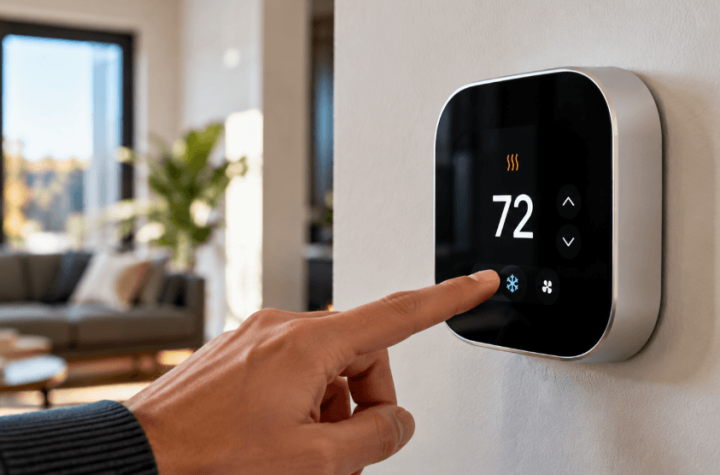
Apple and Schneider Electric have introduced a new smart thermostat designed to help homeowners manage heating and cooling costs through automated temperature adjustments and electricity usage insights. The device, developed for Apple’s new Home Collection, is expected to launch in the United States and Canada in early 2027.
The thermostat integrates with Apple’s smart home ecosystem and uses iPhone-based intelligence to adjust indoor temperatures according to household routines, occupancy, and electricity pricing.
Apple and Schneider Electric Introduce New Smart Home Thermostat
Schneider Electric announced the thermostat as part of its collaboration with Apple to expand connected home technology and improve residential energy management.
The device will be available for a suggested retail price of $199.99, while optional room sensors will cost $39.99 each. Apple’s announced pricing is slightly lower, at $199.95 for the thermostat and $39.95 for the sensors.
The product enters a competitive smart thermostat market that includes established alternatives from ecobee and Google Nest.
Ecobee thermostats currently range from approximately $139.99 to $259.99, while Google Nest models are priced between $99 and $280.
Unlike some competing devices, the Schneider Electric thermostat operates directly through the Apple Home app without requiring a separate application or user account.
Adaptive Temperature Automatically Adjusts Heating and Cooling
One of the thermostat’s main features is Apple’s Adaptive Temperature technology, which uses information from an iPhone to determine when household members are home, away, or preparing for the night.
The system automatically adjusts heating and cooling settings based on these patterns, reducing the need for homeowners to create or regularly update temperature schedules.
Users can also control the thermostat through Siri, allowing voice commands to change indoor temperatures.
The automated approach is intended to improve convenience while reducing unnecessary energy consumption when a home is unoccupied.
Clean Energy Guidance Could Help Lower Electricity Costs
Beyond temperature automation, the thermostat includes Apple’s Clean Energy Guidance feature, which is designed to help households use electricity during periods when energy is cleaner or less expensive.
For customers enrolled in compatible utility rate plans across the contiguous United States, the system can shift heating and cooling activity toward lower-cost periods.
This capability may be particularly relevant for households with time-of-use electricity plans, where utilities charge different rates depending on demand and the time of day.
Apple Home App Provides Electricity Usage Insights
The Apple Home app will display information about energy consumption, including peak and off-peak electricity rates.
These insights could help homeowners better understand how heating and cooling affect monthly utility bills.
Actual savings will depend on factors such as local electricity prices, utility plan compatibility, household energy consumption, and heating and cooling requirements.
Optional Room Sensors Improve Temperature Monitoring
Schneider Electric will also offer optional sensors that measure temperature and humidity in individual rooms.
These accessories allow the smart home system to gather more detailed information about indoor conditions rather than relying exclusively on measurements from the thermostat’s installation location.
The thermostat can also use compatible sensors integrated into Apple’s HomeView, HomePod, and HomePod mini devices.
Matter and Thread Support Improve Smart Home Connectivity
The thermostat supports Matter, a connectivity standard designed to improve compatibility among smart home products.
It also supports Thread networking, which can maintain local device connectivity during an internet outage.
For installation, the thermostat includes near-field communication technology that allows users to begin pairing by holding an iPhone near the device, even before the thermostat receives power.
Apple says information handled through the Home app is protected with end-to-end encryption.
Schneider Electric Announces New Apple HomeView Mounting Accessories
Alongside the thermostat, Schneider Electric introduced three magnetic power mounts designed for Apple’s new wall-mounted HomeView device.
The accessories provide different installation and power options for homeowners.
The available configurations include:
-
USB-C power mount: $59.99
-
Hardwired AC power mount: $79.99
-
Power over Ethernet mount: $129.99
The hardwired configurations are designed to conceal cables inside walls, providing a cleaner installation.
The USB-C and hardwired AC versions are scheduled to become available in Apple stores on November 13, 2026.
The Power over Ethernet version is expected to arrive in early 2027.
Smart Thermostat Launch Scheduled for Early 2027
Schneider Electric plans to release the thermostat and optional room sensors in the United States and Canada during early 2027.
The company is also expected to provide additional product information at CES 2027 in Las Vegas, one of the technology industry’s major annual trade shows.
Consumer Control Remains an Important Consideration
As smart thermostats become more closely connected to utility programs, consumer control over automated temperature changes remains an important consideration.
Some utility demand-response programs allow electricity providers to adjust participating customers’ thermostat settings during periods of high demand.
One commenter discussing the announcement described a previous experience with an ecobee thermostat connected to Xcel Energy, claiming that the utility restricted manual temperature adjustments during summer conditions.
The account highlights why homeowners may want to understand the terms of any utility-connected energy management program before enrolling.
However, the reported experience does not establish that Schneider Electric’s new thermostat will impose similar restrictions.
Apple Expands Its Smart Home Energy Management Ecosystem
The collaboration between Apple and Schneider Electric reflects growing interest in smart home technology that combines convenience, energy efficiency, and automated electricity management.
By integrating occupancy-based temperature adjustments, utility pricing information, room sensors, and connected home controls, the new thermostat aims to make residential heating and cooling more responsive to everyday routines.
Whether it delivers meaningful electricity bill savings will depend on real-world performance, compatible utility programs, and individual household usage when the device reaches consumers in 2027.

John Irving writes for Bjournal, covering news, politics, business, technology, sport, entertainment, and lifestyle. He focuses on clear, reliable reporting and useful information, helping readers stay informed about current events, emerging trends, and stories that matter.


More Stories
Higher Diesel Prices Improve Biodiesel Economics as Global Biofuel Demand Raises Land-Use Questions
Amazon Suspends 21 Air Cargo Operations After Fatal Miami Runway Crash
George Lucas Unveils Long-Awaited Museum of Narrative Art in Los Angeles