
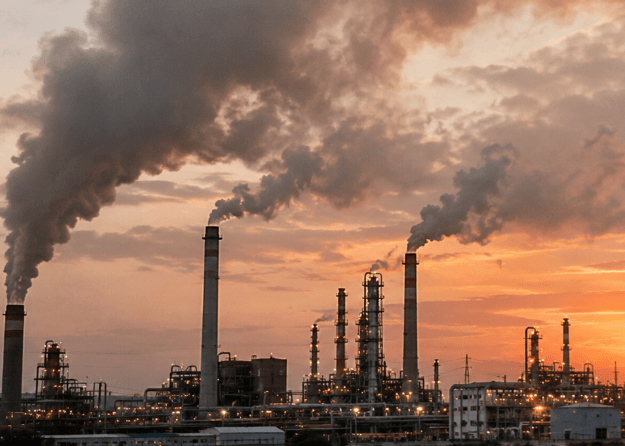
Global carbon dioxide emissions are expected to decline slightly in 2026, but scientists say the reduction reflects economic disruptions caused by the war in Iran rather than meaningful progress in combating climate change. A new international study suggests that rising energy prices and interruptions to oil supplies have temporarily reduced fossil fuel consumption worldwide.
Global Carbon Emissions Fall 0.4% in 2026
According to the Global Carbon Project, worldwide carbon dioxide emissions from burning fossil fuels are estimated at 42.2 billion U.S. tons (38.2 billion metric tons) in 2026, representing a 0.4% decrease compared with 2025.
Although the decline marks a change in the trajectory of global emissions, researchers caution that it does not necessarily indicate a lasting transition toward cleaner energy.
Instead, the reduction appears closely linked to disruptions in global energy markets following the war in Iran, particularly restrictions affecting oil shipments through the Strait of Hormuz.
“It’s downwards which sounds good, but this is largely driven by the war in Iran, what’s happened in the Strait of Hormuz,” said Glen Peters, a study co-author and scientist at Norway’s CICERO Center for International Climate Research.
“So in a way, a little bit of good news, but for the wrong reasons.”
Iran War and Strait of Hormuz Disrupt Global Oil Supplies
The conflict in Iran has effectively closed the Strait of Hormuz, one of the world’s most important shipping routes for crude oil and petroleum products.
The disruption has pushed global oil and gasoline prices higher, affecting transportation, manufacturing and energy consumption across multiple economies.
For the United States, fluctuations in international crude oil prices can influence gasoline costs, transportation expenses and broader inflation pressures.
Researchers found that the energy market disruptions corresponded with significant changes in emissions from different fossil fuels.
Oil Emissions Record Largest Decline
The Global Carbon Project identified three major changes in fossil fuel emissions during 2026:
-
Oil: Carbon dioxide emissions declined by nearly 2%.
-
Natural gas: Emissions decreased by approximately 0.3%.
-
Coal: Emissions increased by 0.6%.
The sharp decline in oil-related emissions was particularly significant because it differed from the gradual reductions scientists would expect from a sustained transition to renewable energy.
Coal emissions continued to rise, indicating that global dependence on carbon-intensive energy sources remains substantial.
Scientists Link Emissions Decline to Energy Market Shocks
The Global Carbon Project’s annual assessment involves more than 140 scientists who analyze energy consumption, fossil fuel use and emissions data from countries around the world.
The researchers combine available information with projections for the remaining months of the year to estimate annual global carbon dioxide emissions.
Their findings were presented during United Nations climate negotiations in Antalya, Turkey, and published in Earth System Science Data Discussions and Nature Climate Change.
Peters said researchers were confident that the emissions decline was associated with the Iran conflict because of both the timing and the types of fossil fuels affected.
Sudden Oil Emissions Drop Differs From Long-Term Climate Progress
Scientists explained that a lasting reduction driven by renewable energy expansion and declining fossil fuel dependence would generally occur more gradually.
In such a scenario, oil-related emissions would approach a peak before entering a sustained downward trend.
However, the pattern observed in 2026 showed a sudden change rather than a steady decline.
“If the overall carbon dioxide emission drop were due solely to a rise in renewables and a systemic drop in fossil fuel use, oil emissions would slowly come up to a peak and then slowly decline afterward, whereas what we see this year is oil emissions are going up and then suddenly BANG, down 2%,” Peters said.
The abrupt shift suggests that reduced oil consumption resulted primarily from supply disruptions and higher prices rather than structural improvements in the global energy system.
Previous Carbon Emissions Declines Highlight Economic Disruptions
Global carbon dioxide emissions have fallen during previous periods of major economic disruption, including the COVID-19 pandemic and the 2008 global financial crisis.
Such declines demonstrate how reduced industrial activity, transportation and energy demand can temporarily lower greenhouse gas emissions.
However, temporary reductions do not necessarily translate into lasting climate benefits if fossil fuel consumption rebounds when economic conditions stabilize.
Researchers emphasize that sustained emissions reductions require long-term changes in energy production, transportation, industrial processes and fossil fuel dependence.
Climate Goals Require Sustained Reductions in Fossil Fuel Use
The latest findings underscore the difference between temporary declines in carbon pollution and lasting progress toward international climate targets.
Although global emissions are projected to fall modestly in 2026, the reduction has been driven largely by geopolitical instability rather than coordinated climate policies.
Scientists warn that the world must achieve sustained reductions in fossil fuel emissions to limit global warming.
The 2026 figures offer a reminder that lower carbon emissions alone do not necessarily signal progress against climate change. Without lasting changes in how energy is produced and consumed, the environmental benefits of this year’s decline could prove temporary.

John Irving writes for Bjournal, covering news, politics, business, technology, sport, entertainment, and lifestyle. He focuses on clear, reliable reporting and useful information, helping readers stay informed about current events, emerging trends, and stories that matter.



More Stories
Apple and Schneider Electric Unveil Smart Thermostat Designed to Reduce Energy Bills
Higher Diesel Prices Improve Biodiesel Economics as Global Biofuel Demand Raises Land-Use Questions
Amazon Suspends 21 Air Cargo Operations After Fatal Miami Runway Crash